
George Robinson
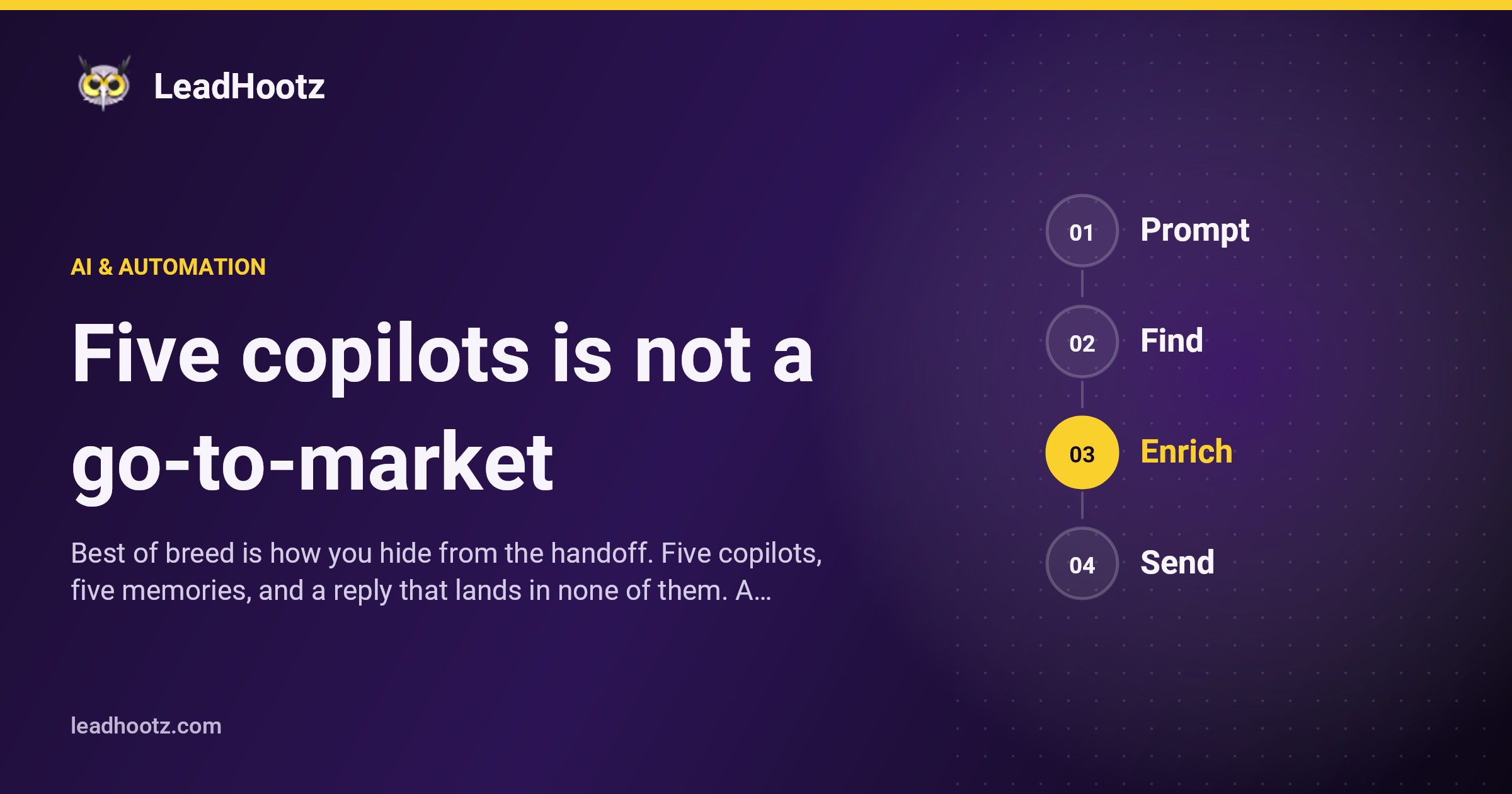
Five copilots is not a go-to-market
Best of breed is how you hide from the handoff. Five copilots, five memories, and a reply that lands in none of them. A go-to-market is one motion, or it is theatre.
Read more →
Coverage is a coward’s metric. AI made the file free and the excuse better. Teams still celebrating how much of the TAM they touched are about to teach spam filters their brand.

For a decade, lead gen was a coverage sport. Who had the bigger file. Who could email more of the TAM before the domain got tired. The teams with the database won the argument in the board meeting, even when the pipeline said otherwise. Finance liked coverage because it looked like an asset. A spreadsheet with forty thousand rows feels like property. A reply does not. A reply is a person, and people are inconvenient to capitalize.
AI just made the file cheap. A plain-English prompt can describe an ICP and pull a pond of names that used to take a researcher a week. Waterfall enrichment can fill the emails you are willing to pay for. If your plan for the next two years is “now we can touch everyone,” you have automated the part that was already losing. You did not get an advantage. You got a faster way to be ordinary.
The buyer is not waiting for your larger file. 6sense’s 2024 study of 2,509 recent B2B buyers found most of the decision is already made in private: 85% set requirements before they contact sales, 81% pick a favorite before any rep is on the phone, and 69% of the journey is over before a seller engages. The favorite wins more than 80% of the time. A cheap list does not put you on that short list. It puts you in the pile they have already decided to ignore. The report is their own page, not a recap.
This is the unpopular version: the list was never the product. The conversation was. Coverage was a proxy we used when conversations were hard to count and databases were expensive. The proxy is now a lie. Anyone can generate the proxy before lunch.
Ask a revenue meeting what “good” looks like and you will still hear a percentage of TAM. Touched. Sequenced. Enriched. Those numbers go up when you lower the standard for who counts. They go up when you enroll last year’s export again under a new campaign name. They go up when nobody is sitting in the inbox, because an empty Unibox does not subtract from coverage. Coverage cannot go down unless you choose to work fewer people. Choosing fewer people looks like a lack of ambition. It is the only ambition left that the inbox will reward.
A static TAM file makes the lie durable. UK-SaaS-series-B-final-v7.xlsx still looks complete a year later, after half the champions have changed jobs and a third of the companies have raised, missed, or died. Completeness is not freshness. The essay is your TAM file started rotting the day you exported it. AI that rewrites the file every morning does not fix the rot if you still enroll eight thousand names because the enroll button is no longer scary. Cheap names are how you teach filters your brand. Eighty names still teach you more than a lake.
Finding a title at a company got cheaper. Guessing a work email and hoping got more expensive, because buyers and mailbox providers both got better at ignoring the guess. A verified address still has a cost. A mobile still has a higher one. A reply still requires a reason that would be false if you waited a month. None of those got cheaper because a model can talk.
LeadHootz is built around that split. Find Leads can search a wide pond — the public line is 350 million contacts you can describe in plain English — and that pond is a place to fish, not a place to live. The daily work is the fish that jumped: hiring, funding, a job change, a pricing-page visit, someone already talking in public. Enrich the hot slice. Credits move when a match is found, not when a provider shrugs. That is not a billing footnote. It is the only enrichment math that survives a finance review, which is the whole point of the price of a miss should be zero and the credit-only enrichment playbook.
Most teams buy the list and call it lead gen. Then the list sits in a sheet, enrichment sits in another tab, the sequence sits in a tool that has never seen the research, and the reply — if there is one — sits in a personal inbox nobody has been assigned to. That is not a system. That is five leaks. The LeadHootz motion stack is the unfashionable claim that find, enrich, share, sequence, and Unibox are one job. Skip a layer and the motion stalls. An unenriched list bounces. An unshared list surprises the client. An uncapped sequence burns the domain. A sequence with no Unibox is a send log pretending to be a pipeline.
Run it as a unit, in this order, or do not quote the volume.
Here is the number people like to steal. In a published LeadHootz story, Indigo SEO sourced over 50,000 contacts for one client and reached them inside a month: a 24% open rate, more than 5,000 site clicks, 10 enquiries, 7 of which became paying clients. Another operator cut about four hours a day of LinkedIn prospecting. Those are on the case studies and in the 2026 GTM briefing. They are field notes. They are not a quota.
The controversial reading is that 50,000 worked because a motion was already real: a list of record, enrichment that did not bill the misses, a mailbox, a human who took the ten enquiries. Copy the numerator and skip the stack and you will not get seven clients. You will get a domain that Gmail has opinions about, and a dashboard that still says “sourced.” Volume is the last step of a motion that already converts a small slice. It is a terrible first step. The 14-day founder plan starts at 50 to 150 rows for a reason. Grow after the titles that never reply have been dropped, not before.
Faster does not mean more steps. Faster means the gap between a true event and a line that names it. Hiring this week. A raise this quarter. A pricing-page visit that never became a form — the ghosts on your pricing page already raised a hand, and your CRM missed them. A dormant deal that went quiet because timing was wrong, not because the problem vanished. Reopen it by naming the new event. “Just checking in” is how you announce you have nothing new. The dormant-deals playbook is blunt about this: change the person if they never answered, and do not congratulate a raise at midnight.
If the signal is three weeks old, it is not a signal. It is a museum label. Do not let an agent dress it up as news. The model will do it cheerfully. Cheerful is not a control. The control is a field you can read — recent funding, the role, the date — and a rule that an empty field does not get a paragraph. That is what playbooks are for. A chat box will write poetry. A column you can sort will tell you to wait.
Lead gen does not end. The scoreboard changes. The teams that look busy will be the ones touching the most logos. The teams that book meetings will be the ones who treated a cheap list as a reason to be more selective, not less. If your AI roadmap is “touch more of the TAM,” it is a roadmap back to 2019, with a nicer loading spinner.
Best of breed is how you hide from the handoff. Five copilots, five memories, and a reply that lands in none of them. A go-to-market is one motion, or it is theatre.
Read more →
Personalization at scale is a compliment with a mail-merge. If the line would still be true in six months, delete it. Buyers are done paying attention to fluency.
Read more →
The AI SDR that “runs pipeline while you sleep” is a scheduler in a person costume. It can prepare the meeting. It cannot be the reason anyone answers.
Read more →